Introduction
The new Government’s Chief Data Officer believes in the huge untapped potential of public sector data. And so do we at the Open Data Exchange (ODX). Our data is so powerful that it could really help to change our country’s fortunes.
As Britain struggles with its place in the world, we believe that backing the technology sector and approaching many questions from a “what does the data tell us?” standpoint could unlock resources and help us fix some of our intractable problems.
We now have a Department for Science, Innovation and Technology (DSIT), which aims to advance data quality, accessibility, and ethical use across government agencies. It focuses on promoting innovation, productivity, and resilience. The government has said it is committed to improving our experience of public services such as health, education, transport and, of course, housing, through responsible and collaborative data practices.
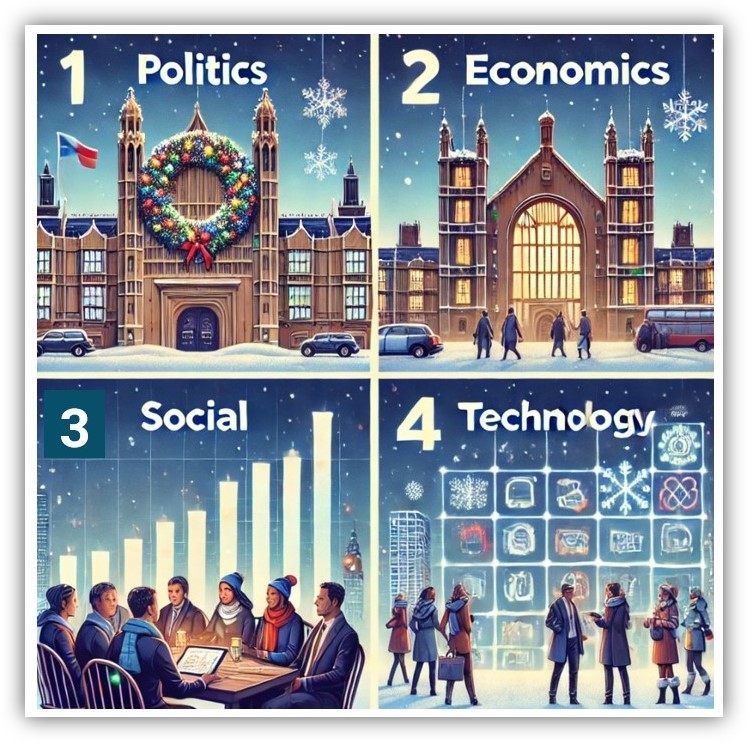
PEST is the acronym for Political, Economic, Social and Technological. Let us consider the political, economic, social and technical issues associated with using public data to tackle housing inequalities.
Political
We have a new Labour administration with a growth agenda, a commitment to public service reform, plus an understanding of the value of IT and data.
As the UK Government’s Chief Data Officer said, they have a National Data Strategy:
“As part of the new digital centre for government in the Department for Science, Innovation and Technology (DSIT), we will continue the journey to improve quality, use and reuse of data across government in a responsible and ethical way. We will also turbo charge innovation, productivity, and resilience with data across the public sector, and transform the public experience of interacting with government”.
In practice, for the Housing Sector, this should mean
- A commitment to support Open Data in Housing, and support for safe data sharing to improve services.
- An awareness of the value of agreeing common standards for data collection and comparison, mandating one way of counting across assets for example.
- Making all government interactions with the public, charitable and private sector simple and reliable ensuring that collaboration and partnerships are customer focused.
At ODX we exist precisely to express these principles for the housing sector. We are campaigning actively and will support housing and technology providers to achieve this voluntarily and to showcase what can be done. We can show the politicians how it is done, in our innovative sector. If you want to support our campaign sign up to our newsletter, where we discuss what this could mean to transform the sector, improve customer services and save money.
Economics
Social housing margins are falling dramatically. Aging homes, safety costs and tenant needs means higher spend on homes.
Open data provides an opportunity to reduce these costs:
- Pool damp and mould diagnostics, using AI to speed up rectification.
- Accessing what both residents and maintenance contractors know about your homes
- Benchmark granular costs and compare providers
- Make asset data accessible to residents, local staff, and boards so that the right response is made to every repair request.
- Use data on repair requests, time taken, and associated costs to identify patterns and order proactive work. Predictive analytics could help anticipate and prevent problems, leading to fewer emergency repairs, which typically are more costly than planned maintenance.
Indirectly open data could save money for maintenance contractors – for example, allowing them to quote more accurately, effective deployment and logistics in each postcode area, and pooling knowledge and resources to get the jobs done quicker, better and cheaper.
The tech sector could use our data to produce products to benefit consumers – just as we now have reliable bus waiting times on an app or Google Maps, drawn from TfL and similar open data.
And for regulators, investors and auditors all the information that providers hold would be much more accessible, comparable and verifiable.
Social
Open data gives our residents (and people who are in desperate need of a home) access to everything they need to know about their home, including the history of the repairs, improvement plans, and service quality. Once social landlords get used to sharing everything they know with residents they start to build trust, which is sadly lacking at present. Board, tenant groups, and investors will be able to see how much is being invested and the impact. This is what accountability means.
In addition, open performance data, like repair response times or tenant satisfaction scores, at an individual home or estate level would incentivise housing providers to listen to what is important for each tenant and strive to meet their wishes.
By pooling data – from residents, contractors, local authorities, other housing providers, etc – the sector gets a thousand times better at revealing what needs doing. It would also encourage organisations to work together to share programmes, insights, and even resources.
Open Data is a radical challenge to the status quo. Providers are fearful of letting go of their information store. However, we believe it is the easiest and cheapest way to change tenants’ experience and perceptions. And it would allow us to make a greater impact from the money we invest.
Technology
Many housing organisations have technology that fails to provide a great experience for either residents or the staff that work for them. Our vision is for a simple, similar, shared system that every housing association, however small, can rely on.
It needs to be simple.
Simple like buying something on Amazon or booking a hotel on Booking.com. Compare your experience in ordering a repair compared to ordering a book for example. Or trying to get something complex resolved like a long-standing leak or noisy neighbour. You do not need to spend a day in an office with post-it notes logging a “customer journey” to know how infuriating our systems are.
Our giant data bases are locked up by legacy suppliers who have the cheek to charge us for meetings these days!! The data needs to be there when we need it. For example, repairs history and investment plans need to inform day to day repairs ordering. The technology exists to do this.
It needs to be similar.
We are calling for common standards, so we all collect the same data in the same way. We are big supporters of @HACT’s work on behalf of the sector to make this happen.
We wouldn’t dream of producing our financial accounts with different approaches. That is why the sector has agreed SORP. We wouldn’t think of carrying out gender pay gap analysis using whatever methodology we can dream up. We agree common definitions.
And it needs to be shared.
Speaking of gender (and race) pay gaps – we are obliged to publish them. So everyone knows where we stand and it gives us an incentive to try to narrow them. We feel the same about sharing housing performance and property information. Shared data standards mean we can share our data anonymously (protecting the resident) and continually, knowing that we are comparing similar things. Outliers can ask why before the regulator asks them, for example.
There is a further reason why Open Data is such a game changer. It provides a foundation for developers, startups, and tech companies to create applications and services that address specific needs in social housing. For instance, new tools might visualise maintenance schedules, optimise energy efficiency, or enhance tenant communication, fostering a more tech-driven housing sector.
If you have enjoyed opening our PEST analysis, please sign-up for our newsletter – we will try to send it out every month in 2025. We are making great strides and building support, and we want your involvement in this important campaign.